


Disclosure: Some of the claims and quotes below may be difficult to read, particularly for Sam O’Neill’s family or friends. I have included them only to illustrate how opponents of MAiD often rely on speculation and misinformation to advance their agenda, seemingly without regard for the harm such claims may cause. Sam O’Neill’s family and friends have my full compassion, respect, and support in their court challenge and it has been an honor to get to spend time with both Gaye and Jim, as this charter challenge unfolds.
False claim #1: The O’Neill’s goal is monetary compensation
This case is a Charter challenge. The court must determine whether Sam O’Neill’s rights were violated when she was required to move from St. Paul’s Hospital to another location in order to receive medical assistance in dying (MAiD).
Importantly, this case is not about financial compensation. The O’Neill family is not seeking damages, they are seeking change. In fact, the plaintiffs’ lawyers, the firm Arvay Finlay, are representing the case pro bono. A review of the firm’s work shows a long history of involvement in human rights litigation, including cases related to Indigenous rights, sexual orientation, race, disability, and other Charter challenges tied to social justice issues. Notably, the firm also represented the plaintiffs in Carter v. Canada, the landmark Supreme Court case that led to the legalization of MAiD in Canada.
The Charter rights at issue in this case are Section 2 and Section 7.
Section 2 of the Canadian Charter of Rights and Freedoms protects fundamental freedoms, including (a) freedom of conscience and religion, (b) freedom of thought, belief, opinion, and expression, (c) Freedom of peaceful assembly, (d) freedom of association.
This charter challenge is specifically concerned with section 2(a). This particular safeguard protects both the freedom to uphold and practice one’s own beliefs and the freedom from having others’ beliefs imposed upon you.
Section 7 of the Charter states that:
“everyone has the right to life, liberty and security of the person and the right not to be deprived thereof except in accordance with the principles of fundamental justice.”
This section has repeatedly been interpreted by Canadian courts as protecting an individual’s autonomy over significant personal decisions, including medical interventions. It also protects individuals from laws or state actions that disproportionately interfere with those rights. As noted by lawyers of Arvay Finlay, an individual’s control over their bodily autonomy should lay at the heart of healthcare and the law.
False claim #2: Jim O’Neill (Sam’s father) is no longer involved in the case
On the Jan 27th episode of The Kelsi Sheren Perspective, Kelsi Sheren and Alex Schadenberg of the Euthanasia Prevention Coalition(EPC) engaged in a shameful discussion about Jim O’Neill’s involvement in this Charter challenge (26:27).
To begin, Schadenberg said: “I’m not going to make any insinuation … but you’ll notice that the original court case was filed by the mother and the father of Samantha. And now you notice that it’s only the mother that’s named as plaintiff. It’s the mother and Dying with Dignity, etc., and a couple of doctors who are happy to kill people.” Schadenberg further went on to say “What happened to the father? … He was the one who was being the supportive parent and he’s not part of it now.”
Sheren responded, “Maybe I should reach out to dad and maybe we should see if we could have a conversation … why is it that you are no longer partnering with Dying with Dignity? Is it because they’re manipulating and utilizing your child to promote more murder?”
I’m going to skip over the remainder of what Sheren and Schadenberg had to say—particularly the speculation about a family they know nothing about.
There is an entire segment of this episode dedicated to making uninformed claims about the O’Neill family, delivered with a complete lack of decorum, care, or compassion. In fact it reflects the exact opposite: reckless and deeply insensitive.
It’s hard to overstate how inappropriate this kind of commentary is.
From all the records I have been able to find, the plaintiffs have always been Gaye O’Neill, Dying with Dignity Canada, and Dr. Jyothi Jayaraman. It is not unusual for only one family member to be listed as a plaintiff, even when multiple relatives are involved. In this case, Gaye O’Neill’s role as administrator of Sam O’Neill’s estate may help explain why she was chosen but this is unconfirmed. *Since the release of this post, Gaye has clarified that it was the lawyers of Arvay Finlay that chose her as the first plaintiff.
A useful comparison is Carter v. Canada. In that case, the Carter family plaintiffs were daughter Lee Carter and son-in-law Hollis Johnson. But contemporary reporting made clear that Lee Carter, Marie Carter, and Hollis Johnson were present at Kay Carter’s death in Switzerland. Her son, Price Carter, spoke publicly about both the restrictions of Bill C-14 and his own decision to pursue MAiD after being diagnosed with terminal cancer. In other words, the fact that only one family member was named as a plaintiff did not mean the rest of the family was uninvolved. That would be an absurd conclusion1. It is hard to imagine that other members of Kay Carter’s family were not part of the five year long legal fight that ultimately led to the legalization of MAiD.
The point is simple: the fact that only one family member is named as a plaintiff does not remotely justify the leap that other relatives have “tapped out” of the case.
This is a perfect example of the speculative nonsense these two put into the public sphere and then allow to circulate as though it were fact. They claim to be motivated by compassion, but there is nothing compassionate about speaking this coldly about a grieving family. I sincerely hope they did not attempt to contact Jim O’Neill. If they did, I hope he told them exactly what he thought of them and their speculation.
To be absolutely clear, Jim O’Neill is deeply and passionately involved in this case. If Schadenberg had done even the most basic fact-checking2, he would have seen the widely published photo from January 12, 2026 showing the O’Neills with Dying with Dignity Canada CEO Helen Long outside the courthouse in B.C.
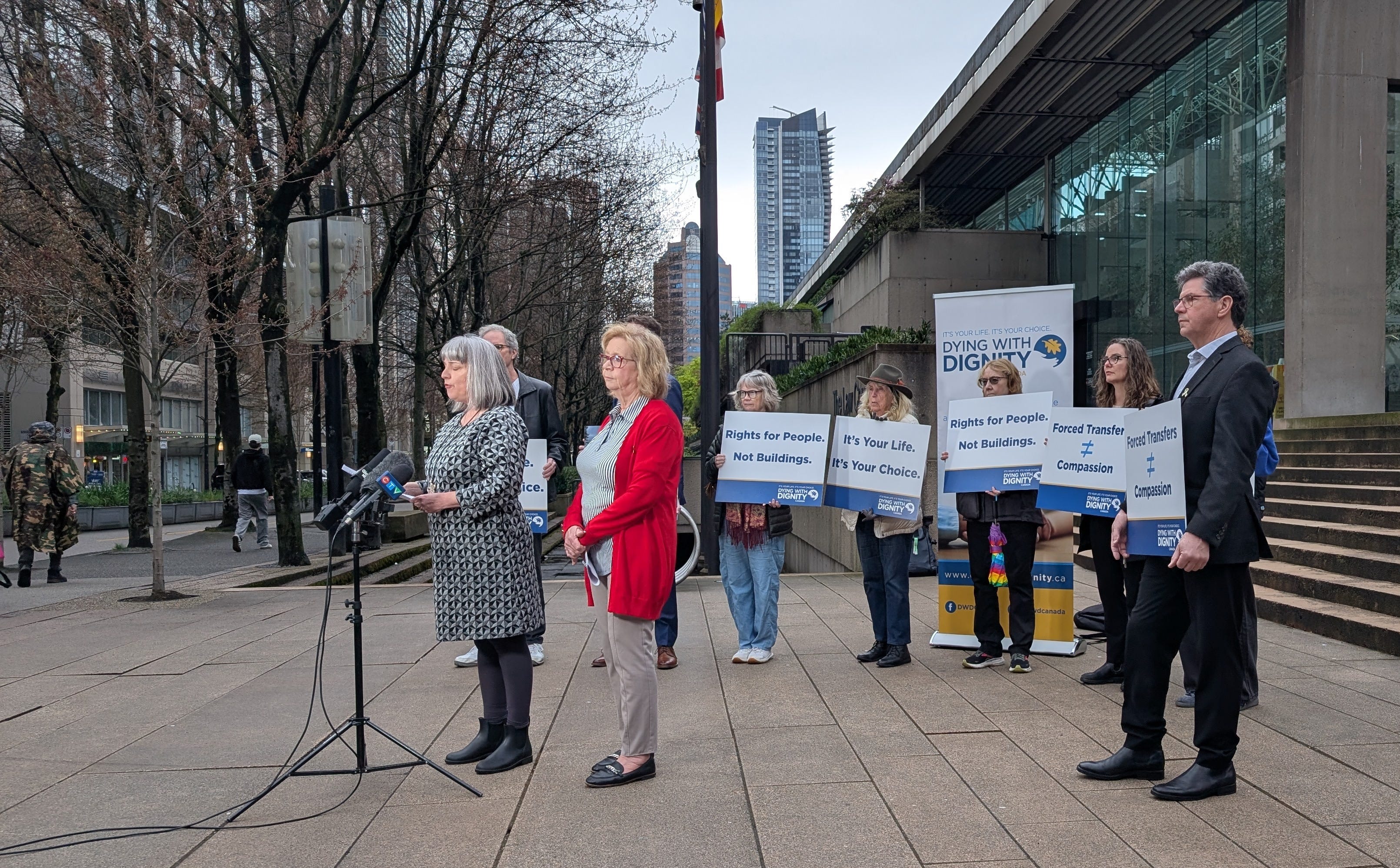
More than that, both Gaye and Jim O’Neill were present in court every day for the first two weeks of proceedings, and again for the final arguments starting April 13. I know this because I attended many of those court days myself. It was during that time that I had the honour of meeting Gaye and Jim. They are thoughtful, caring, and deeply committed people. We spoke many times about the proceedings, but more importantly, we spoke about Sam. They shared stories, photos, and videos of her in healthier days. They also spoke openly about their own lives, what the past few years have been like, and what they hope this Charter challenge might accomplish. Having spent time with them again during final arguments last week, it is clear their commitment and determination to this cause has never faltered.
Kelsi and Alex, before speculating about a family member’s involvement in a case like this, try checking the facts first. Making cold-hearted assumptions about this family just underscores what’s already clear: fact-checking—and compassion—don’t seem to be your strengths.
False claim #3: St Paul’s is funded by the Catholic Church
Comments have occasionally suggested that if the Catholic Church is providing funding for St. Paul’s Hospital, and other Providence Health Care (PHC) sites, it should be able to govern those facilities according to Catholic beliefs alone.
To clarify this claim, I contacted Providence Health Care directly. Shaf Hussain, who represents Public Affairs, Communications and Stakeholder Engagement for Providence Health Care, confirmed in an email that:
“The Catholic Church does not provide any operational funding for our health programs. That funding comes almost entirely from the provincial government.”
In addition, the Providence Health Care Mission FAQ page states:
“PHC is both a ministry of the Catholic Church and operates under an affiliation agreement with Vancouver Coastal health. Our funding comes through VCH, the Ministry of Health and private donors, through the St Paul’s Foundation”.
While Providence Health Care operates within a Catholic tradition, the health care delivered at facilities such as St. Paul’s Hospital is funded almost entirely through the public health system—funded by your tax dollars.
Interestingly, their mission also states that:
“at the heart of Catholic health care is a deep respect for the intrinsic value and dignity of every human being and an unwavering commitment to serve all people, from all background and faiths.”
Taxpayer dollars fund almost the entirety of the daily operational costs of this hospital. Yet patient care is filtered through the moral perspective of the Catholic Church, as well as the ideological lens of the Archbishop, Richard Smith. With regard to MAiD, they claim to “respect the personal beliefs and legal rights of our patients and residents” and yet this legal medical service is out of reach while within its walls. If you want MAiD on premises, you’re expected to take your tax-paying self somewhere else.
I appreciate PHC’s mission statement that they “do not impede access to the lawful MAiD request process. Instead, we work closely with the Ministry of Health’s MAiD Care Coordination Services to ensure that requests are addressed in a safe, respectful, and timely manner”. It has been well documented, in both the media and court proceedings, that in the early years of MAiD, patients were forced to leave the premises even for their assessments. PHC has clearly improved its approach since then, but refusing to allow MAiD on site and requiring transfers against a patient’s wishes remains an impediment to access.
False claim #4: Transfers for MAiD are as routine as any other transfers
According to Schadenberg, “There’s nothing new about transferring people….In fact, with the way medicine is set up right now, most people can expect at some point to be transferred for some sort of situation for their care.” Sheren responded with “transfers are very normal….It’s no big deal. You get transferred all the time.” (19:47)
We have heard Schadenberg make these kinds of statements before, including during an EPC live event in Vancouver, BC in May 2025. According to Schadenberg, being transferred from St. Paul’s Hospital to another facility for MAiD is no different than being transferred when a hospital does not provide a particular medical intervention an individual requires.
For example, if a patient at St. Paul’s Hospital requires radiation therapy as part of their cancer treatment, they would need to travel across the city to receive that treatment at the BC Cancer Agency, because radiation is not provided at St. Paul’s Hospital.
At first glance, this comparison may seem somewhat reasonable. But it overlooks crucial differences.
Patients who travel to another facility for treatments or interventions not offered at their current facility, are usually choosing to access care that is simply not available where they currently are. If that treatment were available at their current location, most patients would understandably opt to receive it there rather than travel across the city.
Sam O’Neill had already been assessed and found eligible for MAiD by two clinicians, meaning she had the legal right to receive MAiD. Yet she was required to leave St. Paul’s Hospital in order for that care to be provided. In other words, her access to MAiD was not limited by medical capability of that facility, but rather by the hospital’s policy grounded in its faith-based values. Had O’Neill been initially taken to Vancouver General Hospital, a secular facility, we wouldn’t even be discussing this story.
These claims also disregard the reality of what many palliative patients are experiencing. For someone with bone metastases, even slight movement can be excruciating, and can even cause pathological fractures. For those experiencing shortness of breath from advanced cancer, interstitial lung disease, or advanced chronic obstructive pulmonary disease (COPD), even simple acts like talking, eating, transferring from a bed to a stretcher can cause severe breathlessness.
If these individuals cannot tolerate even minimal movement or basic tasks, how can transferring them across the city be considered “no big deal”?
In addition, these patients may choose to tolerate potentially difficult transfers to another facility with the hopes that the test or intervention provided will benefit them in some way. Forced transfer to another facility for MAiD serves no benefit, only burden.
O’Neill’s autonomy was constrained and her agency stripped away. There was no path forward that didn’t require her to withstand additional harm. If she wanted MAiD she would have to endure physical suffering to transfer to another location and her family would have to psychologically suffer alongside her. Or she could remain at St Paul’s Hospital and not have MAiD which meant continuing to endure intolerable suffering until her natural end.
That was not a choice, it was coercion by circumstance and imposed suffering.
This was also not a simple transfer, as Schadenberg implied.3 O’Neill was experiencing severe and complex pain that was difficult to manage even with minimal movement. For someone in that condition, a transfer across the city was not a minor inconvenience—it’s a significant physical burden. O’Neill had to be sedated to tolerate the transfer, resulting in an inability for her to have meaningful final moments with her family.
And unlike the radiation example, this was not a trip she chose to make. It was a transfer she was forced to endure because of someone else’s religious beliefs.
False claim #5: Shoreline Space is a reasonable solution to external transfers
For those unfamiliar with “Shoreline”, this is the name given to the space created by Vancouver Coastal Health (VCH), to accommodate patients in St Paul’s Hospital who want to proceed with MAiD. It is important to note that this space was established after Sam O’Neill’s death, following a directive from the provincial Ministry of Health, and therefore was not available to her at the time.
“MAiD is a legal end-of-life choice, and we’re ensuring it is accessible in a way that supports and respects patients, their loved ones and health-care providers,” said Adrian Dix, Minister of Health. “I have directed VCH to take space next to the hospital and establish a clinical space and care setting for VCH use. This new dedicated clinical space will be established for patients at St. Paul’s Hospital to access compassionate and dignified MAiD services.”
Shoreline is not an adequate solution for a number of reasons:
It is unlikely that all patients’ care needs will be able to be accommodated in the Shoreline space. As discussed during the trial, it functions as an outpatient or adjacent area rather than a fully equipped inpatient unit. As a result, patients with more complex care requirements may not always be able to be supported there. This may include patients who require continuous intravenous medication infusions for symptom management, advanced oxygen delivery, or regular oral or tracheal suctioning. I have been involved in transferring patients with these kinds of care needs to tests as quick and easy as a CT scan or x-ray. There is nothing straightforward about the process.
According to testimonies and court discussions, moving a patient to an adjacent space requires coordination and effort from both Vancouver Coastal Health and Providence Health Care. Depending on the patient’s care needs, this might be significant coordination. A separate case discussed in this charter challenge demonstrated how complicated the coordination became for a patient with a continuous medication infusion pump. That patient needed the medication for symptom management—but who would manage the pump when they transferred from an inpatient unit to Shoreline space? Could an infusion pump pose a potential barrier to accessing MAiD at Shoreline? The coordination process, I expect, takes time and resources that could instead be directed towards supporting the patient in the location where they are already receiving care.
Patients and their loved ones often develop strong therapeutic relationships with their care team, particularly when they have been in a hospital unit for longer period of time. Imagine being cared for by the same nurses, physicians, social workers, spiritual care providers, and allied health staff over weeks or months, only to be told that at the moment of your death—possibly your greatest hour of need—that those members of your care team are not permitted to be present to support you. Instead, you would be supported by a group of mostly strangers.
This is not meant to diminish the work of the incredible care teams receiving these patients in their final moments. But the reality is that there is far less opportunity to build a therapeutic relationship with a patient from St. Paul’s Hospital when the care team may only meet them on the day of their death.
As someone who has supported patients having MAiD, I often met them on the same day giving me less than an hour to get to know them and the loved ones present. Despite my best efforts, it’s simply not possible to build the kind of therapeutic relationship in that time that can develop over weeks or even months of care.
As mentioned above, being separated from the care team with whom a patient has built a trusting supportive relationship can create a sense of medical abandonment. Being told that one’s choice at the end of life cannot be supported by the hospital where they have received care may feel like abandonment by the care team, the hospital, the health authority, or even the broader health system.
For some patients, this experience may be particularly distressing if they have previously felt abandoned by the health care system. This is especially relevant for individuals from marginalized communities, who may already carry a history of difficult or exclusionary experiences within medical institutions.
Finally, this is not a demonstration of cost effective healthcare. According to statements in the court proceedings of the O’Neill case, as well as media coverage, Shoreline Space cost Vancouver Coastal Health just over $2.7 million dollars to construct. For the year of 2025, twenty-seven individuals were transferred to Shoreline for their MAiD provision. If we were to assume in 2026 there will be the same number of transfers to Shoreline, that would equal 54 provisions over 2 years. The individual cost for each provision would therefore work out to just over $50,000 per provision! Imagine what the health savings would be if MAiD provisions were permitted to occur on site at St. Paul’s Hospital, with MAiD being administered by a third party provider.
This is what is being proposed by the lawyers of Arvay Finlay as a solution to this challenging situation. Now, what is going to happen when St Paul’s Hospital opens its doors in 2027 at its new location? Will a new Shoreline space need to be constructed?
False claim #6: If the charter challenge is successful practitioners working in facilities run by Providence will be required to be involved in MAiD
According to Schadenberg “what’s being demanded is that every institution must provide euthanasia”. (18:49) This is false.4
Since the introduction of MAiD in Canada, health care providers have always been permitted to conscientiously object to participating in MAiD.5 That has not changed, and we would not want it to change. A person’s conscientious objection is a fundamental right and must be respected and protected. Examples might include nurses or social workers choosing not to act as independent witnesses for MAiD requests, or nurses declining to insert IVs for MAiD or be present in the room during a MAiD provision. It can also be physicians opting not to complete MAiD assessments or act as providers, or pharmacists declining to dispense MAiD medications. All of these are examples of conscientious objection to involvement in MAiD, and this will not change due to this or any other case.
I have been involved with MAiD since its inception, and at no point have I witnessed health care providers being told that they must personally participate in MAiD.6
In fact, in the year between the Supreme Court’s decision and the passage of Bill C-14, health authorities were already encouraging staff to inform their team leaders if they intended to conscientiously object to involvement with MAiD. This allowed care teams to understand who would be willing to participate, ensuring continuity in supportive care for the patients and loved ones.
Within our interdisciplinary palliative team, discussing our views about MAiD early on proved fruitful. It gave us space for open, honest conversations about how we each felt, helping us understand and support one another while honouring the wishes of the patients in our care.
That said, health care professionals are expected—by both our regulatory colleges and our health authorities—not to abandon our patients. For example, if a physician objects to even discussing MAiD, they are expected to ensure the patient is referred to another clinician who can discuss the request. They cannot simply ignore a patient’s inquiry or request for MAiD.7
Similarly, nurses are expected not to dismiss or ignore a patient’s expression of interest in MAiD, but to refer the patient to the most appropriate member of the care team if they are not comfortable answering a patient’s questions.
More broadly, nurses are expected to continue providing care for a patient who has chosen MAiD, even if they personally disagree with that decision. Health care professionals may conscientiously object to direct participation, but they cannot conscientiously object to caring for the patient.8
In practice, this is no different from many other areas of health care. Patients often make decisions that members of the care team might not personally agree with. Nevertheless, our professional responsibility is to support patients and provide compassionate care, even when their beliefs differ from our own.
If this charter challenge were completely successful, Providence Health Care (PHC) could be required to allow an outside provider, such as a Vancouver Coastal Health(VCH) physician or nurse practitioner, to enter the PHC building and provide MAiD on site. This would happen without any PHC staff direct involvement or the use of PHC resources.
But where would this leave PHC staff, particularly nurses, social workers or physicians who want to support their patient at the time of provision? Can they be present in the room when MAiD occurs as long as they aren’t actively participating (i.e inserting IVs or administering MAiD medications)? I can pretty confidently assume that not all PHC staff identify as catholic, nor even agree with the Catholic mission statement upheld by PHC. If they were barred from being present at a MAiD provision, would it violate their section 2(a) right to not have religion imposed upon them or their practice? Food for thought…9
Final thoughts…
This Charter challenge has completed its final week before the Supreme Court of British Columbia, and it will likely be months before Chief Justice Ronald Skolrood delivers his judgment. The O’Neill family has indicated their willingness to be involved in appeal processes and, if necessary, take the case to the Supreme Court of Canada should the outcome not favour the plaintiffs. I will continue to follow this Charter challenge, and the misinformation that will no doubt emerge along the way.
Subscribe to stay updated on this and all things MAiD.
Absurd conclusions are not something new for Sheren and Schadenberg.
Fact Checking would be something new for Sheren and Schadenberg.
I do wonder how many medical transfers Schadenberg has actually been involved in. My guess is far fewer than the hundreds I’ve personally had to organize. You should probably believe my transfer expertise over his speculation.
Schadenberg might say he means is that “every institution must [allow] euthanasia [to happen on site]. This might be an example of how little accuracy he applies to how he talks about MAiD.
Section 241.2(9) of the Criminal Code makes clear that no individual is compelled to provide or assist in providing MAiD. By contrast, eligibility limitations—such as the exclusion of mental illness as a sole underlying condition—are found elsewhere in the section.
In fact, if I witnessed that demand, I would be the first to ensure the health care provider knew that participation in any part of MAiD is a choice.
For example, this is from the CPSBC guidance on MAiD.
“Q. If a physician is a conscientious objector, are they required to assess a patient for eligibility for MAiD?
A. No. Physicians who choose not to perform MAiD are not required to assess their patients’ eligibility for MAiD. However, while they are able to make a personal choice not to provide MAiD based on their values and beliefs, CPSBC expects physicians to give their patients information and assistance to allow them to make informed choices for themselves. This includes advising patients that other physicians may be available to see them, and/or directing them to an agency or health authority.”
For Example, this is from the BCCNM Guidance on MAiD.
“Nurses are responsible for safe, competent, ethical, and culturally safe care for all clients, including those requesting MAiD according to the Duty to Provide Care practice standard. Personal beliefs must not interfere with the provision of general nursing care, such as:
Assistance with hygiene and toileting
Providing fluids or food when requested
Monitoring comfort and symptoms
Post-mortem care after MAiD
Nurses cannot refuse to provide general nursing care to a client who has requested MAiD. Nurses are not required to provide or assist with MAiD but must continue to meet their professional obligations.”
It is an almost certainty that PHC will continue to dictate what medical procedures its staff can witness or participate, and this will certainly exclude MAiD.
Thank you for dispelling misinformation and holding space for truth and healing.
My heart goes out to Sam's family.
I was a hospice volunteer in a Catholic-owned building.
It was heartbreaking to watch families turned away in those final tender moments.
I felt deep shame being part of a system that claimed compassionate support ..
Until MAiD was involved. We were unable to comment, leaving families feeling abandoned and judged.
Thank you! ☮️🙏💜
The courage it must take for Sam’s family to relive her MAID experience over and over, in order to prevent other families from enduring the same pain, is awe-inspiring. That they should be subject to anything other than admiration and sympathy is shockingly disrespectful.